Mechanical drafting services have evolved recently because of changing technology and demands in industries. Mechanical drafting is a critical step in the design and manufacturing of products; hence the importance of drafting in designing accurate, detailed, and efficient models of components or systems. Thanks to advancements in technology as well as the adaptation of new ideas, drafting has never been as precise, collaborative, or versatile as it is now. This article will examine current trends affecting mechanical drafting services and how they transform engineering and manufacturing industries.
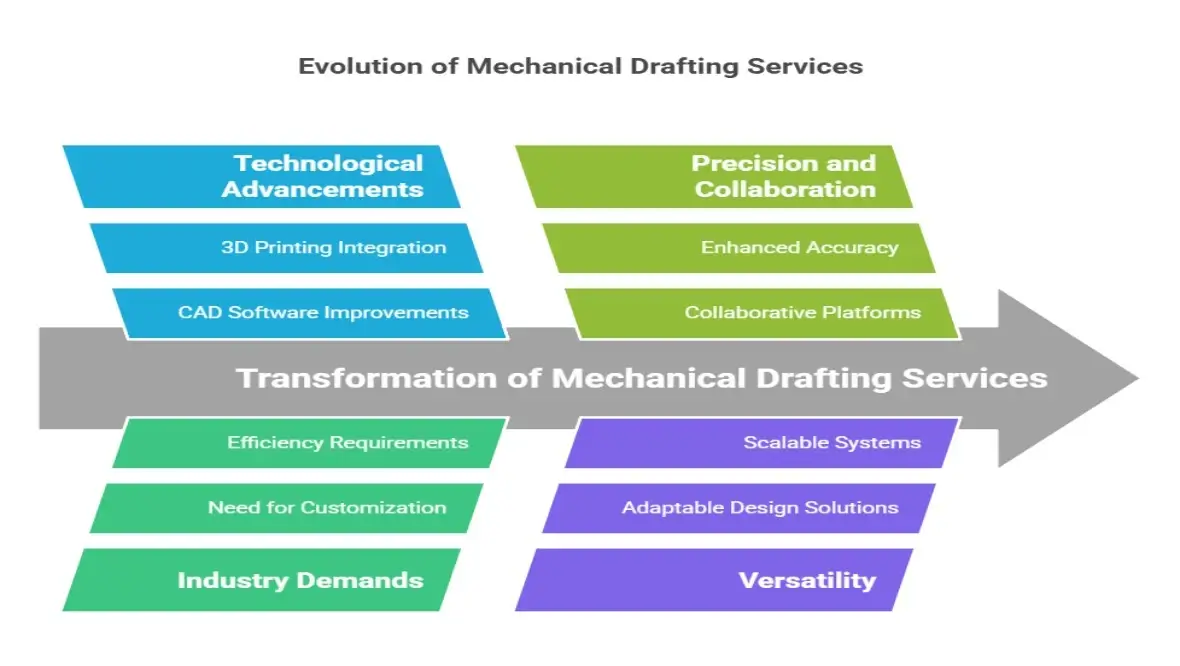
The Digital Transformation of Mechanical Drafting
The change from conventional drafting to drafting tools was a revolution in mechanical engineering. Today CAD software is leading the market, as with the help of special programs, engineers can develop accurate 2D drawings and 3D models. These trends of digitization have promoted the development of new trends in efficiency, accuracy reduction, and collaborative processing at an international level.

Trends Shaping Mechanical Drafting Services
1.The Rise of 3D Drafting and Modeling:
Although 2D drafting is still important in some fields, 3D drafting is more popular among industries since it provides an overall visualization of the elements and a detailed aspect of the visual cause of the design by the engineers. This capability increases knowledge, clarifies difficult structures, and supports the simulation of the real product. Businesses and companies, like automotive, aerospace, and manufacturing industries, among others, use 3D models for modeling their products to enhance their quality.
2.Integration of Artificial Intelligence and Machine Learning:
Technologies such as AI and machine learning are helping mechanical drafting upgrade repetitive manual work and provide sophisticated design insights. Today’s drafting tools integrate artificial intelligence to recommend enhancements and identify where something may be wrong with the design and its feasibility in manufacturing. By using predictive analytics based on machine learning algorithms, engineers can envision certain hurdles and avert them before drawing their designs to save time and money.
3.Cloud-Based Drafting Platforms:
Software as a service is disrupting the ways mechanical drafters work together in this industry. Online drafting tools allow multiple people to collaborate on projects, and the documents can be accessed from anywhere. Several people, such as engineers, designers, and manufacturers, can use and modify the files in their own time, thus eliminating instances where information has to pass through multiple portfolios before reaching the concerned personnel. They also provide safe storage of data, the ability to manage versions, and compatibility with other engineering tools, making these platforms mandatory for modern drafts.
4.Emphasis on Sustainability and Eco-Friendly Design:
Sustainability is gradually emerging as a central issue in mechanical drafting services. Drafting tools have become widely employed in engineering applications to realize designs with less material and energy consumption. One can also use computer-based programs to create models that determine the effects of the product at every stage of its production. To this effect, it is possible to adapt international requirements of sustainable development at the business level, subsequently minimizing costs and resource use.
5.Augmented and Virtual Reality in Drafting:
Specifically, AR and VR are transforming the role that engineers play regarding mechanical drafts. These technologies support virtual visualization that helps stakeholders observe and physically navigate through the developed designs. AR and VR enable enhanced design reviews, improve client communication, and provide insights into potential flaws before going into production. With an increase in the availability of these tools, their incorporation into drafting services is presumed to experience steady growth.
6.Parametric and Generative Design:
Parametric design, which parametrically links design variables and relations, has become an effective direction in mechanical drafting. It enables an engineer to make corrections to a design in the quickest mode possible while ensuring that previous work remains standard. In generative design, an evolved form of this idea, several designs are created with the aid of artificial intelligence given specific requirements. These approaches allow creativity and save time in the drafting process while coming up with excellent solutions.
7.Industry-Specific Customisation:
Mechanical drafting services are becoming more specialized to the type of industry in which they will be used. For instance, in the healthcare industry, drafting tools are used in the development of complex structures of unique medical products with sensitive features. In construction, drafting services concentrate mostly on parts of the building and how the systems can be incorporated. Specificity guarantees that drafting transcends typicality to meet challenges specific to certain fields, thus enhancing its results.
8.Enhanced Simulation and Analysis Tools:
Today’s mechanical drafting has become more than just drawing components on flat media. Current drafting software has sophisticated simulation and analysis features that enable engineers to test designs under real-world conditions. These tools allow measurement of stress, heat, and motion as well as provide information about performance and the ability to endure strain. They also integrate in a way that means one does not have to build many physical prototypes to design a device efficiently and effectively.

Conclusion
Mechanical drafting services remain highly relevant to today’s engineering and manufacturing industries because drafting provides the basis for creating accurate, practical, and advanced design solutions. From 3D modeling to AI, cloud collaboration to sustainability trends, this field is reshaping the ways engineers conceive products. Through these innovations, companies will be in a stronger position in the market and can create high-quality products that meet future needs.
Leading BIM services provider. Adding Innovation and Excellence to the BIM Services.