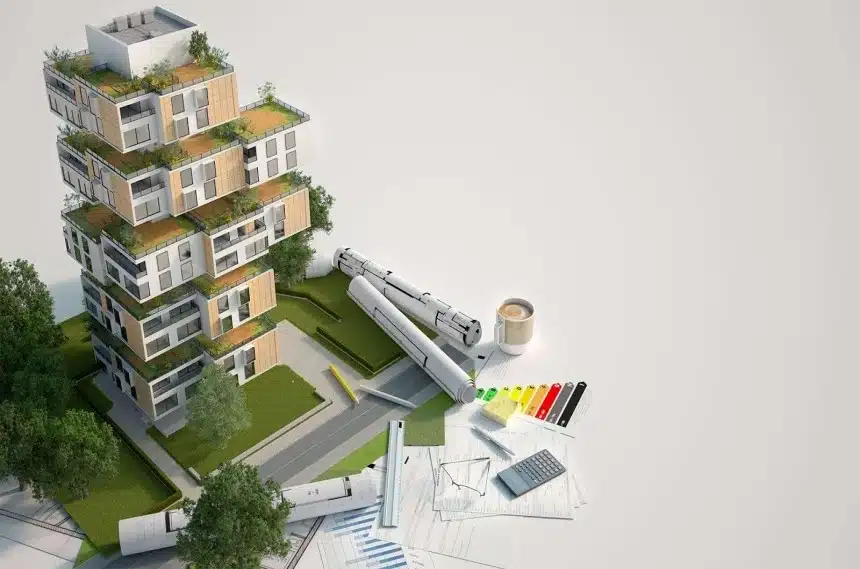
The construction industry has been rated as one of the most environmentally unfriendly industries in the world due to its exploitation of natural resources and its production of large volumes of waste. However, there is an interesting and unprecedented transition going on in the industry due to the increasing focus on sustainability in the global economy. The driving force here is Building Information Modeling (BIM), the tool that is changing the face of facility design and construction. Making use of BIM for sustainable construction is not just a trend but a necessity for creating a sustainable built environment. In this blog, we will explore the role of BIM in sustainable construction and how it is a game changer for greener buildings.
The Role of BIM For Sustainable Construction
BIM, a digital model of a building, has also emerged as a basis for maintaining sustainable construction. By creating an integrated working environment, BIM assists architects, engineers, and builders in easily assessing a project from the initial design stage to the construction phase up to the demolition.
In this approach, all the steps and stages are embraced to attain the sustainability goals of the building projects.
The largest benefit of the implementation of BIM for sustainable construction is that it can effectively increase resource efficiency. In particular, BIM software allows for optimising the number of materials necessary for construction and applying non-waste principles to manage resources and impacts on the environment.
Also, with energy performance simulation, BIM delivers information on a building stock’s energy use, which allows for improved decision-making in enhancing energy performance.
Enhancing Energy Efficiency
Sustainability is important when it comes to energy considerations in construction and BIM stands out in this area.
From BIM tools, integrated project delivery teams can estimate the energy performance of buildings through simulation. Such aspects as solar heat gain and the need for insulation, as well as methods of heating and ventilation, are included. Because the possibility of inefficiencies can be seen at an earlier stage of the design process, BIM makes it easier to design energy-efficient structures that comply with green buildings.
In addition, BIM for sustainable construction can incorporate renewable energy systems, including solar panels or wind turbines, in the construction plan.
They are flexible and can be simulated before execution so that efficiency and costs are maximized during the implementation process.
Waste Reduction and Resource Management
Waste that is generated from construction activities is undesirable because so many tons of waste end up in dump sites.
BIM comes in handy in this by providing the data needed for estimating the required materials as well as organizing the construction process.
Virtual modelling can eliminate the instances of over-purchasing, thus minimizing the wastage of resources inherent in traditional modeling strategies.
Moreover, the team uses sustainable materials by disseminating information concerning their properties and sustainability features.
This enables teams to filter for materials with sustainable characteristics, for example, materials with low carbon footprints or high recyclability.
Facilitating Green Certifications
LEED (Leadership in Energy and Environmental Design), BREEAM (Building Research Establishment Environmental Assessment Method), and others are certification standards in the green building industry. These certifications involve documentation and analysis, which BIM excels at accomplishing.
The basic capability of BIM comprises detailed reports on energy performance, water efficiency, and material usage that make the certification process smoother.
It helps to meet the high requirements of green building codes, thus making BIM for sustainable construction an important tool for reaching and demonstrating environmental performance.
Lifecycle Management and Durability
Sustainability is the practice relative to construction focusing on all aspects related to the life-cycle of the building. Being an effective tool to model a structure, BIM makes lifecycle management possible by creating a digital replica of the structure.
It enables the evaluation of performance for building managers alongside scheduling and management of maintenance tasks that may help in increasing the durability of buildings. For instance, BIM can predict when certain parts of a building may need replacement or repair, thus avoiding unnecessary renovation and saving more.
This ensures that the functionality of the building is also sustained for the entire period the building serves its purpose.
Overcoming Challenges in Adoption
Although the implementation of BIM for sustainable construction can revolutionize the construction industry, it comes with some considerations.
BIM itself has high demands regarding software, time, employees, and anything related to the organization of the project.
Also, sometimes while implementing new technologies management can face the problem of management and organizational resistance. Nonetheless, the benefits of the implementation of BIM are far-reaching in the long run as opposed to the challenges experienced in the initial stages.
Due to increased awareness of the benefits of BIM when it comes to delivering on the sustainable agenda, the adoption of the technology is set to become the norm within the construction sector.
A Greener Future with BIM
The ability to incorporate BIM for sustainable construction is a breakthrough in creating a more sustainable environment. With collaboration, resource utilization, and energy efficiency, BIM Services Provider enables the construction industry to leave a smaller impact on the environment. Incorporating efficient ideas such as BIM remains compulsory in the current world, where issues like climate change and resource exhaustion are apparent. BIM should not be viewed just as a purpose in the construction project but as a revolution. The versatility to incorporate sustainability in each stage of a project makes LEED a good friend in developing sustainable structures. BIM Services Provider increases the prospect of sustainable development in the manufacturing segment and more broadly in the construction industry, as the concept prospers within construction practices.
Leading BIM services provider. Adding Innovation and Excellence to the BIM Services.