Building Information Modeling (BIM) is becoming more popular in the construction sector. The Levels of Development in Construction (LOD) is an essential concept within BIM, serving as a marker for the level of detail and trustworthiness of information contained within a BIM model at each phase of a project. Range of LOD is available from 100 to 500, each being increasingly refined and tailored representations of the source. This blog will look into what LOD is, provide the differences between LOD 100 and LOD 500, and examine how these levels affect construction projects. The Levels of Development in Construction’s framework plays an integral role in this process, ensuring that all project stakeholders are on the same page and that accurate information is transferred from the earliest stages of conceptualization to the final as-built documentation
The Significance of Levels of Development in Construction
The LOD establishes a common language for specifying the reliability and completeness of a BIM input. At each phase of a project, different stakeholders, architects, engineers, contractors, and facility managers, need varying levels of detail to perform their tasks properly. Not only do levels of development in construction define geometric information, but they also encompass related data like material properties, dimensions, and maintenance requirements. This approach of aligning expectations on LOD allows teams to mitigate misunderstandings, avoid expensive rework, and ensures that the BIM model remains a true source of truth throughout the project.
Understanding LOD 100 to LOD 500
LOD 100: Conceptual Design
LOD 100 depicts the first level of a BIM model since the elements are still visible only in the form of blocks. At this stage, models are crude and contain geometrical simplifications, and no dimensions or other detailed information. For example, in the schematic view, a wall can be shown only as its symbol which gives information about its location and approximate dimensions. LOD 100 is mostly applied to feasibility and the analysis of building massing, which is useful when the stakeholders need to take a first look at the scale of the future project.
LOD 200: Schematic Design
By LOD 200, models begin to be recognizable in terms of shapes and sizes. Elements are shown proportionally to scale, quantity, and location. Although more detailed than the previous stage, information remains rather general, therefore this stage is best suited for early design and coordination of different disciplines. For instance, a wall at LOD 200 would specify width thickness height as well as generic material properties but might not incorporate the construction or finish detail.
LOD 300: Detailed Design
LOD 300 reflects the shift from design to construction information models. At this level, there is adherence to dimensions, location as well as the material of the different elements. The information is good for construction documentation, cost estimation, and procurement since it is accurate enough. For example, LOD 300 would encompass detailed information about the actual dimensions of a wall, material characteristics, and other dimensions required to guide contractors on how to start developing it.
LOD 400: Fabrication and Construction
The fourth level of development, that is LOD 400, is specifically concerned with fabrication and installation. Models at this level contain all the information needed in the manufacturing and assembling of parts. Design components are created with precision in terms of dimensions, and typical, allowable, and minimum/maximum variations such as tolerances, fabrication details, and connection points. For instance, while at LOD 400, a structural steel beam would contain accurate measurements, material grades, and bolt-hole layouts that can be used for fabrication and subsequent packaging.
LOD 500: As-Built Documentation
LOD 500 is the last level of a BIM model, and it depicts the real state of the completed building. This as-built model contains correct dimensions and details like the sizes and serial numbers of the pieces of equipment, the maintenance schedule, and so on. LOD 500 is extremely beneficial for facility management and future uses related to real estate, as LOD 500 provides all-encompassing information about infrastructure.

The Impact of LOD on Construction Projects
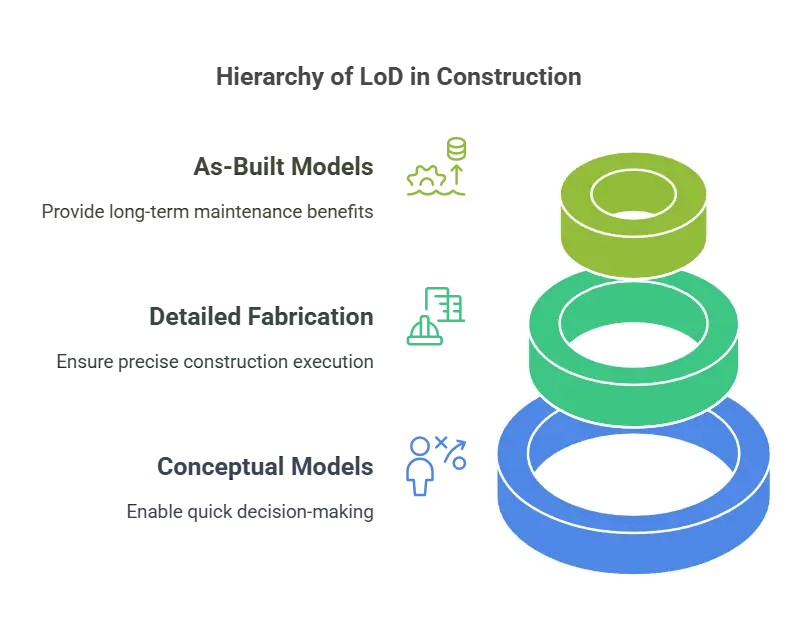
The correct LOD at a certain phase of a project continues to have a profound influence on that project’s effectiveness, precision, and success. This kind of design acknowledges the principle of offering the quantity and type of detail, which is useful to different users at different times while minimizing the inclusion of unnecessary layers of detail. As for early-stage conceptual models, it allow making immediate decisions, and for detailed fabrication models, it allows obtaining accurate construction. Furthermore, as-built models at LOD 500 offer long-term benefits for maintaining and operating the facility since one would not require constant updates.
Well-defined levels of development in construction also have a positive influence on the teamwork of different project teams as this paper has pointed out. Thus, when the expectations match the level of detail needed at a particular step, then the conflict, interaction, and workflow difficulties can be avoided. In addition, when using LOD as a standardized basis, different projects can be compared and verified, allowing organizations to implement higher quality and result in achieving in construction.
Conclusion
When it comes to the concept of the Levels of Development in construction known as LOD, it is critical for achieving the full benefits of BIM Services in construction projects. Conceptual design at LOD 100 up to as-built documentation at LOD 500 is vital for creating a product that provides accurate, reliable, and decision-making information to the stakeholders. When the level of detail corresponds to the project requirements, work is more efficient, fewer mistakes occur, and projects are completed on time and within budget. As BIM advances, Levels of Development in Construction will forever be the guide that will foster advancements toward improving project management in the built environment.
Leading BIM services provider. Adding Innovation and Excellence to the BIM Services.